THE BALANCE THE TRIANGLE LENS AND SYSTEMIC RISK
The Lens
The Balance the Triangle systems lens for understanding how coherence holds—or fails—across scale, pressure, and time.
Technology scales faster than society adapts. Our minds evolved for small groups, immediate consequence, and visible accountability—yet we now operate inside systems that are global, abstract, and incentive-dense.
When capability outruns verification, drift becomes normal. And when drift becomes normal, correction gets expensive.
This lens helps you spot drift early, locate where it’s happening, and choose safeguards that hold under pressure.
The Triangle
The Triangle
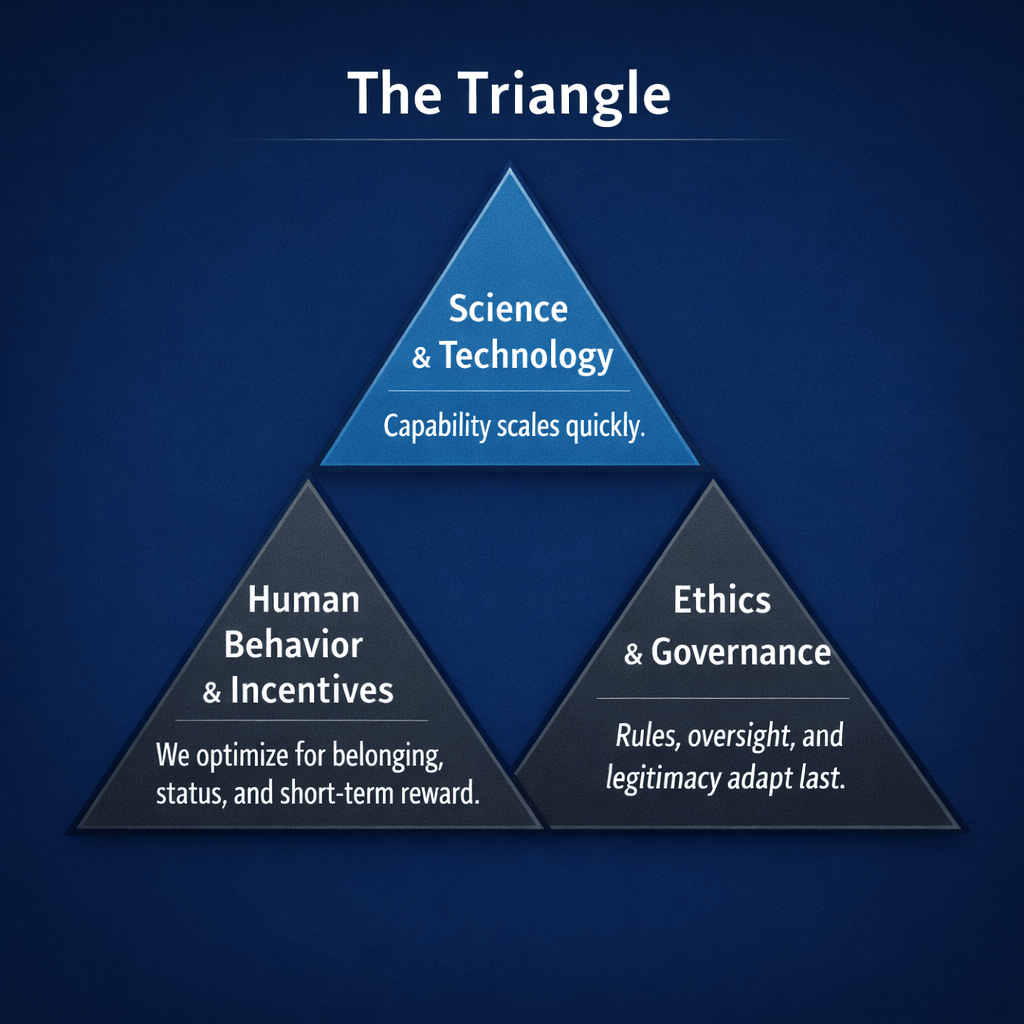
Balance the Triangle is a foundation to this work. This idea that there is fundamental imbalance in the relationship between human technology, institutions, and evolutionary wiring has proven a useful lens in evaluating social risk.
Science & Technology capabilities scale quickly. Our institutions lag behind as their attendant rules, oversight and legitimacy adapt slowly to scale. Finally, we struggle even harder to scale human behaviors that have enabled survival for millennia but find themselves at mis-match and disadvantage in a digital age
Balancing these areas has proven historically difficult. And the current digital transformation exacerbates this at scale and speed.
One Lens, Six Depths
We address the problem in six areas. One lens, six depths—because failures propagate multiply across scale:
- Civilizational — legitimacy, narrative, long-horizon cohesion
- Institutional — laws, regulators, courts, standards bodies
- Organizational / Business — strategy, incentives, procurement, risk ownership
- Team / Community — norms, trust, enforcement, conflict handling
- Individual — attention, identity, fear, status behavior under pressure
- Technological / System — architectures, controls, permissions, auditability
Drift occurs at all levels. Explore all six depths to diagnose where drift is occurring and where it should be corrected. Because if you only “fix” one depth, failure migrates.
The Drift Loop
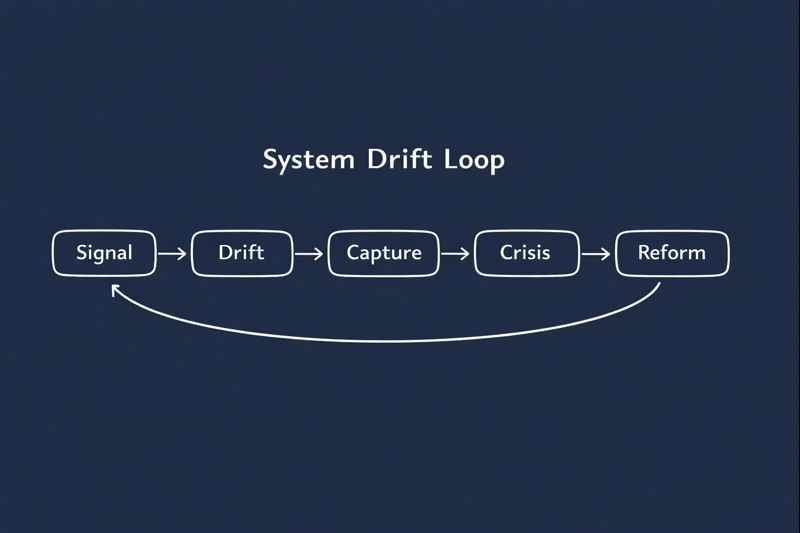
Drift is the gradual movement of a system away from its original intent, safeguards, or purpose under the pressure of incentives, time, complexity, or authority—usually without anyone consciously deciding to change course.
In our frameworks, drift is not moral failure. It is the default behavior of unmanaged systems. Drift is merely what happens when pressure changes behavior faster than safeguards change behavior back.
Signal → Drift → Capture → Crisis → Reform → Signal
This is the path of drift. To address it, small routine correction beats unmanaged crisis-audit correction.
Our goal isn’t perfection—it’s early detection, friction where power concentrates, and correction loops before the bill comes due. These three key elements define sucess at all scales for systemic risk challenges.
Choose your path
Pick a starting point based on what you’re building or trying to repair.
Walking a Strange Savanna (The overall view)
Our field guide to mismatch: Paleolithic wiring, Neolithic institutions, and god-like technology—and what to do about it. This book gives you a comprehensive picture of the what and the why of current systemic risk chllenges.
Controls & Safeguards (Practical counterweights)
Proof survives pressure. Power meets friction. Correction loops prevent drift from turning into crisis. The three key elements and controls and safeguards that provide actionable methods to correct systemic risk.
SpiralWatch (Assurance for AI under pressure)
Relational coherence assurance: evidence packs, scenario banks, fail-closed gates, and correction loops that work when incentives push for shortcuts. This AI software concept showcases practical tool possibilities.
Field Notes (Short, concrete cases)
A living library of failure modes and counter-behaviors—compact, shareable, and designed for real decisions.
The Central Question
How do you build systems where power can’t outrun verification—so correction happens early, routinely, and cheaply?
And in doing so, correct the many systemic risks to human flourishing.
 BALANCE THE TRIANGLE LABS