
HOW SYSTEMS DRIFT
HOW SYSTEMS DRIFT
Systems rarely collapse suddenly.
They drift—until correction becomes unavoidable.
When verification can’t keep up with power, crisis becomes the audit.
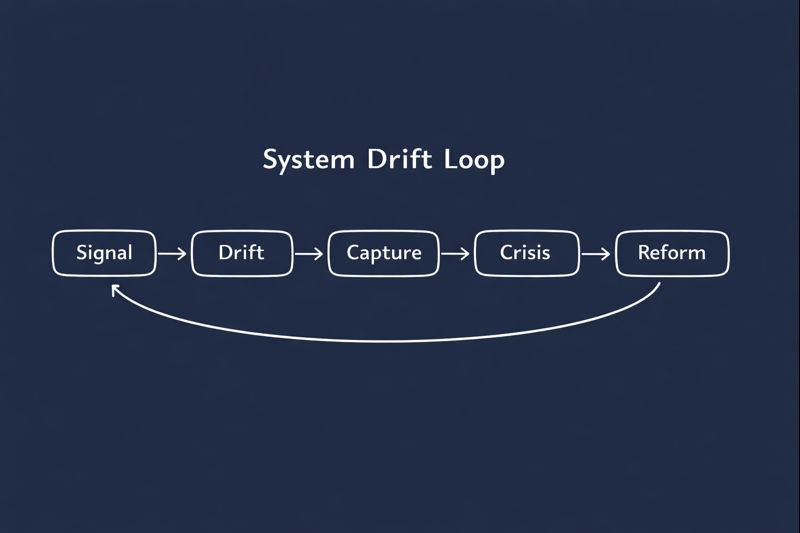
All human systems repeat the same sequence:
Signal → Drift → Capture → Crisis → Reform → Signal
Correction grows more expensive the longer drift goes unseen.
This sequence repeats across civilizations, institutions, companies, communities, and platforms.
Step 1 — Signal
- A new capability solves a coordination problem. Trust is high; verification is minimal.
Step 2 — Drift
- Shortcuts and exceptions accumulate.Dissent becomes socially expensive.
Step 3 — Capture
- Gatekeepers consolidate access and decisions. Oversight weakens or becomes performative.
Step 4 — Crisis
- Reality breaks through—breach, scandal, collapse, backlash. Correction arrives late and expensive.
Step 5 — Reform
- New rules appear. Over time, drift resumes unless correction becomes routine.
The loop is recursive. The cost of correction grows with time.
Drift Is Not Moral Failure
Drift occurs because humans evolved for small groups and authority-based coordination. Modern systems scale across millions through institutions and platforms that can act faster than we can verify.
Drift is a scaling problem.
Safeguards are the upgrade.
Why Crisis Becomes the Audit
Without routine verification and independent oversight, problems remain hidden until reality forces visibility.
- Exceptions accumulate
- Bad news stops traveling upward
- Oversight becomes performative
- Power centralizes under pressure
- Verification depends on authority
When visibility fails, reality restores it—violently.
Why Drift Accelerates Now
Technology scales faster than human behavior and governance can adapt.
- Science & technology accelerate capability
- Human incentives reward speed
- Governance reacts last
Patterns that Reveal Drift Early
Recurring signals show where systems are moving through the drift loop.
- Verification Gap
- Authority Without Friction
- Dependency Trap
- Incentives Outrunning Safeguards
- Exception Drift
- Gatekeeper Capture
- Bad News Suppression
- Prestige → Dominance Shift
- Oversight Theater
- Crisis as Audit
Move Correction Earlier
You cannot eliminate drift. You can reduce its cost.
Verification
Proof survives pressure
Counterweights
Power meets friction
Correction Loops
Small fixes prevent crisis
Correction Without Backlash
Safeguards fail when introduced as accusation. Accusation is a signal failure before it’s a moral event.
When correction arrives as blame, the system shifts from “What’s true?” to “Who’s guilty?” That move reliably destroys the two things drift needs least: shared reality and safe upward flow of bad news.
We use charisma as one clear example because it concentrates attention and raises identity stakes.
When a person (or brand) becomes the trust object, safeguards feel like a personal attack—so verification gets reframed as disloyalty, and correction gets delayed until crisis forces visibility.
Pattern → Risk → Amnesty → Replacement → Independent verification → Routine loops
Where to Go Next
Daily Brief
Signals in real time
Field Notes
Case diagnostics
SpiralWatch
Assurance under pressure
A Simple Question
Where is correction becoming expensive?
If correction only arrives through crisis, you’re already late in the loop.
Balance makes correction cheap again.
 BALANCE THE TRIANGLE LABS